• Skip to primary navigation
  • Skip to main content
  • Skip to primary sidebar
  • Contact Us
  • Pay My Bill
  • Patient Portal
KV Healthcare

KV Healthcare

Your Home for Health

  • Find a Provider
  • Clinics & Specialties
        • Primary Clinics

        • KVH Family Medicine – Cle Elum
        • KVH Family Medicine – Ellensburg
        • KVH Home-based Primary Care
        • KVH Internal & Adult Medicine
        • KVH Pediatrics
        • KVH Women’s Health
        • KVH Rapid Access
        • Specialty Services

        • Anticoagulation Clinic
        • Addiction Medicine
        • Specialty Clinics

        • ENT & Allergy
        • Cardiology
        • Dermatology
        • General Surgery
        • Home Health
        • Hospice
        • Neurology
        • Podiatry
        • Orthopedics
        • Urgent Care
        • Urology
        • Vascular Surgery
        • Workplace Health
        • Wound Care
        • Therapy Services

        • Physical Therapy
        • Speech Therapy
        • Occupational Therapy
        • Cle Elum Therapy Services
  • Hospital Services
        • Services

        • Cardiopulmonary
        • Emergency Department
        • Imaging
        • Laboratory
        • Nutrition
        • Pharmacy
        • Surgical
        • Family Birthing Place

        • About Family Birthing Place
        • Class/Event Calendar
        • What to Expect
        • Birth & Family Education
        • Lactation Services
        • 4th Trimester Resource Center
        • Pregnancy & Infant Loss
  • Patients & Visitors
        • Patient Tools

        • Request Medical Records
        • Checking In
        • Language Services
        • Quality of Care
        • Patient Portal
        • Patient Safety & Security
        • Patient Policies
        • Insurance & Billing

        • Accepted Insurance
        • Price Transparency & Billing Services
        • Washington Health Plan Finder
        • Financial Assistance
        • No Surprise Act - Balanced Billing
        • Insurance vs. Self Pay
        • Bills from Other Providers
        • Pay My Bill
        • Visitors

        • Visiting Information
        • Mother’s Room
        • Café
  • About KVH
        • About KVH

        • About KVH
        • Mission & Vision
        • Board of Commissioners
        • Administration
        • Quality of Care
        • DAISY Award Program
        •  

        • News & Blog
        • Events & Education
        • Contact Us
        • Locations
        • Work With Us / Careers
        • Foundation

        • About the Foundation
        • The Foundation Board of Directors
        • Programs to Support
        • Ways to Give
        • Donate Now
        • Foundation Events
  • Donate Now
  • Pay My Bill
  • Patient Portal
  • Find a Provider
  • Clinics & Specialty Services
  • Hospital Services
  • Patients & Visitors
  • About KVH
    • Mission & Vision
    • Board of Commissioners
    • Administration
    • Contact Us
    • KVH News
    • Our Locations
    • Quality of Care
  • Careers at KVH
    • Culture & Mission
    • Education
    • Providers
    • Non-Clinical
    • Volunteer
    • Nursing
    • Professional Development
    • Clinical
  • The Foundation at KVH
    • Donate Now
    • About the Foundation
    • The Foundation Board of Directors
    • Foundation Events
    • Programs to Support
    • Your Impact
    • Ways to Give

KVH News

Behind the Scenes: Environmental Services

HealthNews · September 10, 2019 ·

Environmental Services

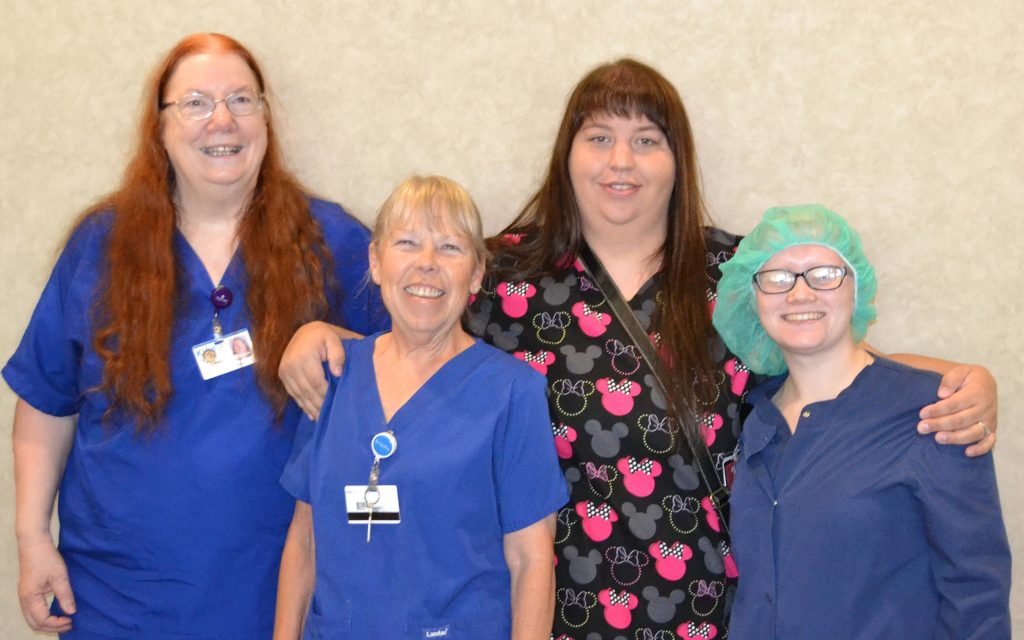
We sat down with some of the team that keeps our facilities clean. 
McKenna – 2 years
Patty – 12 years
Paula (PC) – 31 years
Sara – 10 years

What does environmental services look like? Is it different in patient care areas?

PC: I do the Critical Care Unit, Imaging, Surgical Outpatient, three rooms on Med/Surg, the Doctor’s Room and Social Services.

M: Some deal directly with patients and some don’t. Some of us do offices.

S: I do both. I deal with offices, the cool crew up here, you know, and I deal with patient areas too, so I have both sides.

Who works in the clinics in this group?

S: Me.

P: I used to work in the clinics, and now I’m in the Emergency Department. I really enjoy the faster pace there.

Does environmental services handle the OR? That’s like a whole other level is it not? I mean, I know you have to have things clean, but, like, there’s *stuff* going on in there.

M: It’s pretty detailed. After a surgery, I go in, take up the trash, then move everything to the middle of the room and mop the ceiling, mop the walls –

Why do you move everything to the middle of the room? I’m picking up housekeeping tips.

M: So I make sure I get everything and don’t miss anything.

So you move everything to the middle of the room and then you sweep, you mop –

M: No, we can’t sweep. No dust is allowed back there. I can’t use a duster. You just don’t want a lot of dust in the air. So I mop the ceiling and I mop the walls.

You mop the ceiling? That’s something I didn’t know.

M: Yeah, it’s basically like a microfiber flat mop. So I can throw it away. It’s a one-time use. And I have a pole extension so I can get the ceiling.

That is crazy. But you know there’s a concern that everything be clean, so, okay. Wow. Okay. That’s just the tip of the iceberg, I’m sure.

S: It’s the same as what you do if you have a contact room, like if you have MRSA, you basically have to do the room the same way. With surgeries, you do the ceiling and the whole thing once a day at the end of the day, unless we have totals, which happens on Tuesdays.

(For the more sensitive souls out there, I’ll just summarize what they shared next, and say that total hip replacement surgeries need to be cleaned up after, every time. Now, back to the interview.)

So when you’re doing a room in Med/Surg or CCU, there are different signs on the doors, right? They’re clues that something’s different about this room. Tell me about those.

PC: We have a sign that is brown and that’s enteric. So you clean that with bleach water, 1:10 (ratio) bleach water solution. Droplet is the green sign. We use Virex disinfectant cleaner for that. We have the orange signs for contact. You have to go in there and use your Virex, change curtains, wash walls…

Do you guys mask up for any of this?

S: Yes, and you have to gown up.

PC: With droplet, you have to wear a mask. With contact and enteric, you have to wear a gown.

Is there always somebody here on duty? 24/7/365/Christmas day?

S: Every day, yes. And pretty much all day. From 1:30-3:30 there’s a night janitor available to help with anything that comes up.

PC: I’m here at 4 a.m.

How are the clinics and outbuildings handled? Are there dedicated staff for clinics?

S: There’s someone that does Family Medicine – Ellensburg, Orthopedics, and Pediatrics, so they just clean those. And then there’s someone that just does Radio Hill, Physical Therapy, and Occupational Therapy & Speech Therapy. Then there’s Laura, she does Internal Medicine and Workplace Health. I do Women’s Health, General Surgery, and here (upstairs at the hospital).

So in the hospital, this is the place where cleaning could happen at any time, but with the clinics and the external buildings, it’s pretty much before or after hours.

S: Right. When the clinic staff leaves, then the housekeeper comes and cleans.

Environmental Services is an 18-person crew, plus 3 in Laundry, responsible for keeping clean 135,000 sf of KVH facilities.

Are there any ideas people have about the work that you do that you want to correct?

PC: Well, some people think that literally all we do is mop the floor and collect garbage. It’s more detailed than that. I’ve actually had patients say to me, “Oh, you got the fun job cleaning up after us,”  and I go, “Well, you know, it pays the bills.” (Laughter) And I’ve done it for a very long time. So then they ask me how long, then they say, “Wow, you’re a lifer!”

One of the things I forget is that your jobs are 100% on your feet, all the time.

Is there anything that might surprise us, like mopping the ceilings, about the work you do?

M: You’re tested on how well you clean the room. There are invisible dots everywhere.

Oh, what? Tell me about this!

M: It’s from the company Ecolab. Before surgeries, someone will go in and dot the room with these little invisible dots that I can’t see. After I clean, they go in with a black light and see if the dots are still there.

Is it some kind of substance that would come off if the surface was cleaned, is that the point?

M: And you can’t just wipe it, you have to really rub hard on it to make sure it’s actually gone.

How often does that happen?

M: Several times a month.

S: They do it in Med/Surg and CCU, too. And OB, when you clean the C-section room, there’s a checklist, so someone has to check everything in that room to make sure that it’s clean. So it’s not just your eyes that have been on that, it’s other people, too. So that’s kind of cool.

Well if you think about it, like the number one piece of health advice that people give is wash your hands. And I don’t know if you realize or if people think about how important the work is that you do, because if we didn’t have a clean environment here, can you imagine how sick everyone would be? So, bless you for all you do.

What are the challenges of working in environmental services?

M: When someone calls out sick, because then you’re covering multiple areas.

S: Being in more than one place at a time. It’s like, be here, do this, do that. And the hours, you know, the hours aren’t always super ideal. It’s common for people at KVH to have an 8-4:30 job, but most people in our department don’t.

What are the rewards of working in your department?

S: I would have to say, the people. Speaking for myself, General Surgery, Women’s Health, the people here. At first, I never wanted to work upstairs ‘cause it’s all administrative staff. And now that I’ve been up here, I really like these people. I can get used to working up here, you know?

Let’s put it this way. If you’re that special person who loves cleaning, then maybe that’s what you like. But otherwise I would think it would be about the patients, and the people.

M/S (unison): I like to clean!

PC: I really like interacting with patients.

It must be tough, ’cause you guys have physically demanding jobs, but you have the opportunity to be a bright spot for somebody that’s probably not having a good day. I’m sure you are very much appreciated by patients and families.

What does it take to have a good day at work?

Everyone: Sense of humor!

PC: Also have a positive attitude and respect each other.

How does environmental services support the KVH mission of providing quality patient care?

PC: A clean environment, I would think.

M: We help not to spread infection.

S: Yes, infection control. Make sure everything’s clean.

You’re protecting patients, right? And staff. You should have police badges. I’m seriously in awe of the work you do. Everyone else will be, too.
Chores and Children

Elise Herman , MD · September 5, 2019 ·

KVH Contributor*
Elise Herman
Dr. Elise Herman
KVH Pediatrics

Chores for Children
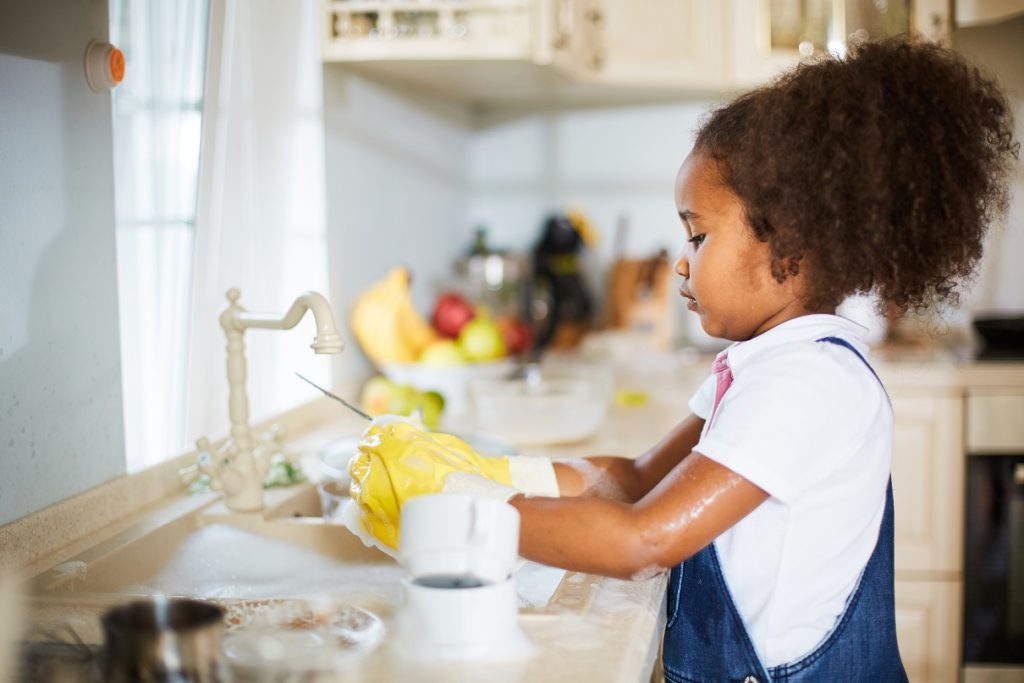
Little girl washing dishes in the kitchen

As parents, one of our goals is to raise our kids to become responsible, independent adults. Part of this process is having kids do chores, although it is safe to say most kids do not see the value in this activity. Besides becoming proficient at basic household duties, chores also teach kids responsibility and the importance of making a contribution. Doing chores makes kids feel needed and valued – even if they complain about it!

Chores seems to be a waning part of family life, squeezed out by pressure for kids to compete academically and be involved in lots of extracurricular activities.  It has been shown, however, that giving kids chores early (starting at age 2-3) leads to good relationships with family and friends, as well as academic and early career success. Besides creating a sense of self-sufficiency, doing chores teaches empathy and consideration for others, according to psychologist Richard Weissboud of the Harvard Graduate School of Education.

So how to make those kids do chores? Ideas abound, including household chore apps and chore charts. Just the way we adults phrase the concept can make a difference. Saying, “Thanks for being a helper” was much more persuasive to kids than “Thanks for helping,” according to a recent study in the journal Child Development. Emphasizing the child’s identity as a ‘helper’ was very motivating. Telling kids that they “get to help” as opposed to “have to help” feeds into a child’s desire to be ‘grown up’.

We all like to have a choice in life – and the same holds true for kids and chores. Listing all jobs to be done and letting kids choose from the list each week increases the odds they will feel positively about their tasks. Rotating jobs is a fair way to divvy up responsibilities. Tying chores to allowance has actually been shown to be counterproductive; when paid to do housework, kids actually are less motivated to work hard and help out the family. When creating a chore chart, remember to be specific, stating the steps to a job. “Cleaning the bathroom” is vague; “scrub the toilet, clean the sink and tub” is more precise and easy to follow.

Being consistent with a time for the family to do chores together makes it more of a group activity – everyone pulling together for the greater good. Phrasing it as a time to do “our” chores as opposed to “your” chores emphasizes that doing chores is a way we take care of each other. Listing time for chores on the calendar makes the expectation very clear. Kids are also more likely to have a good attitude if we remember not to complain about our own household duties – those little ears are listening!

Start kids out early in terms of household responsibilities. Toddlers can help by putting away toys, clearing unbreakable dishes from the table and putting clothes in the hamper. Preschoolers can sweep, wash plastic dishes and empty wastebaskets. By age 8 or 9 kids can load a dishwasher, vacuum, pull weeds, etc. The child “gets to do” more and more as they get older, and you get the satisfaction of raising a self sufficient and responsible child! There might be some grumbling along the way, but doing chores is an important part of childhood and ultimately kids feel good about contributing and becoming more self-reliant.

*Opinions expressed by KVH Contributors are their own. Managed by Kittitas Valley Healthcare, HealthNews does not provide medical advice. For medical advice, please see your healthcare provider.

Behind the Scenes: Engineering

HealthNews · August 30, 2019 ·

Engineering

INTERVIEW #1
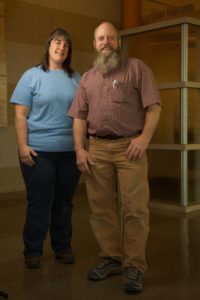
We sat down with the Engineering team to learn more about the ways they take care of KVH facilities. Mitch (team lead, with 12 years at KVH); Terra (department secretary, 11); engineering techs Robert (.5), Tim (8), Jody (26), and Ben (2).

Who’s the go to person for what, on your team? Jody’s the painter.

M: So is Terra. We go to Tim for locks and doors. Robert’s our HVAC guy.

J: Ben’s master plumber.

(To Mitch) And you’re the enforcer.

Tim: He’s the phone guy.

What’s the best thing about working in engineering?

J: We’re never doing the same thing, day after day after day.

What’s the most challenging thing?

M: The frustration sometimes of not being able to fix things as fast as they need to be fixed. It’s challenging. When heating goes down when it’s cold out, or the cooling goes down when it’s hot out, how fast can you get it going?

‘Cause you’re only going to hear from several hundred people.

M: Another challenge is the 13 houses that we own; they need constant care. And then we have all the outer facilities, too.

Including Cle Elum?

M: That’s where Ben is now. Ben’s our Cle Elum guy. We spend a minimum of one day up there every week. We have preventative maintenance that needs to be done. It comes in huge sheets. Hundreds and hundreds of things that we have to do besides emergent things.

There’s a checklist about a mile long is what you’re saying.

Your work covers such a wide range. Can you give me a simple definition for engineering?

M: General maintenance. And sometimes we have to actually engineer something to keep it working.

Any engineering misconceptions you would like to clear up?

Tim: We’re not security.

M: We’re part time security when needed. And we have these little vests we can throw on. Other than that. Yeah. I think they look at us like we are, it’s not what we do.

Any other misconceptions or surprises?

M: I’ll take people on a tour, and they get to talking about the heating and cooling, and to actually see how that works is kind of fascinating if you’ve never seen the large scale of it, with the giant chiller and boilers making hot water and cold water, sent throughout the whole building.

With surgery, there’s things that have to be a particular temperature…

J: And humidity. We have to control humidity. We fought it all last week with the rains.

You can’t change the weather. So how do you control the humidity?

J: By computer. There are units installed that can add humidity or dehumidify the surgery suites.

R: With room temperatures, people have different preferences, but we have to find happy mediums.

M: Our goal is to be 71 degrees. That’s, that’s the happy place, really.

I love that. That should be your motto.

So why do you guys come around to offices with a stick and a piece of ribbon attached to it?

Checking air flow. To see if air is blowing. If not, then that is probably part of your problem.

Now is that one of those checklist things that you do periodically or is that when you’ve got a complaint or both?

M: That’s if there were complaints.

You have supply and you have return. We want to make sure the air that’s being blown in is being taken out. If you go up on the heliport, you open the door to that fan and it’s a hurricane. That’s the kind of pressure it takes to fill the building. And if you’re going to pressurize it, you have to remove it, too. So we’re dealing with huge fans to make this work.

We think of “call” as a patient care thing, but you have 24/7/365 coverage. How does that work?

M: We rotate. We each get one week, through the weekend.

J: From Monday to Monday.

Have you ever been called in in the middle of the night?

J: On a weekly basis, yeah.

“It’s 65 degrees. Get down here!”

R: Sometimes people think we’re not getting to their problems, but it takes time to fix things. And with outside vendors, we’ve got to wait even longer. “I put that two weeks ago.” “Yeah. I haven’t gotten the part yet.” And then there’s money concerns. I mean, if it’s a big item, we’ve got to wait for approval. People can get frustrated waiting.

I think a lot of us are used to instant fixes. Right? Need to get that fixed in 30 minutes or less.

M: You may have a light out right here for you in your office. We go through the work orders and make sure that the patient care items are handled first.

I’ve heard you say that before, that you prioritize patient care. It’s why I’m always shocked when somebody shows up for my thing. I’m like, don’t you have a list a mile long of really important stuff?

R: We might be waiting on a part! (Laughter)

You all work so hard. How do you survive a day in engineering?

J: What keeps me coming back every day is the crew that I work with. The people on this team.

You’re in it together, right? That makes all the difference.

Baseline responsibilities: 2,000 pieces of equipment, 3,597 PMs, and 33 systems

INTERVIEW #2
Director Ron Urlacher currently spends about half of his time focused on facility renovations. He’s grateful for a capable team that expertly handles the department’s ongoing work. Ron shared some additional insights with us about the work of KVH Engineering.

One of the difficult things to wrap my brain around is defining what Engineering does. It seems like a pretty broad spectrum.

Ron: And it is. Maintenance calls – plugged toilets, changing lights, hanging up whiteboards, all those little things – and lots of square footage to take care of, including the district houses, with lawns to be watered daily, garbage to be set out for weekly pick-up, and general maintenance.

When one of those systems goes down you have to put on your problem solving hat. It’s a whole different skill set. Even if you can’t fix the problem, you need to understand the problem so you can call the right contractor and relay the right information so they can come prepared.

For example, let’s say an air handler goes down. You need to determine if it’s a mechanical problem, electrical problem, control problem, or other system feeding it such as boiler or chiller and everything associated with that. With each of these problems come different contractors. It could even be IT infrastructure as our controls are computerized. Anyhow, that’s when the fun starts.

We also handle office moves, interjected into the normal workflow. And there’s all the preventative maintenance that we do. I wish I had a count of the pieces of equipment.

I’m sure it’s hundreds or thousands or…

Ron: Literally. And each piece has to be maintained. Which gets into the world of compliance. A lot of things have to be documented on a regular basis, things that inspectors look for.

How is engineering different in a healthcare environment?

Ron: There’s so much variety. The hospital has 33 distinct systems we manage and maintain. There are some commonalities, but each system is unique. Trying to keep up on the science of all those is a challenge.

How does Engineering support the mission of KVH?

Ron: Through safety, really. Some of these systems are high risk. Like when a patient is on oxygen, the expectation is that oxygen will flow and that’ll flow at the right rate and it won’t be liquid, you know? It’s about creating a safe environment. We work behind the scenes so that you can take it for granted.

Patients won’t even realize that you’re there, because everything is working as it should be.

Ron: Exactly. I always say if they don’t see you, that’s a good thing.

Childhood Obesity

Elise Herman , MD · August 29, 2019 ·

KVH Contributor*
Elise Herman
Dr. Elise Herman
KVH Pediatrics

Childhood Obesity

Childhood obesity is truly an epidemic. In the past 30 years, the percentage of American kids who are overweight has tripled to 17%, or about 1 in 5 children. Additionally, the very heaviest children are even bigger than previously. Adults also have an increasing rate of obesity, but it is especially sad to see kids now dealing with what used to be adult-only health issues due to obesity: Type 2 diabetes, high blood pressure, high cholesterol and lipid levels, fatty liver, sleep apnea and joint problems. Obese children are more likely to grow up to be obese adults, with increased risk of stroke, heart disease, high blood pressure and diabetes.

The emotional and psychological side of obesity is significant as well. These children have greater occurrence of depression, low self-esteem, poor body image and eating disorders. Overweight kids are also more likely to be bullied, compounding their distress.

There is no single cause of childhood obesity, but there are know factors that contribute, including the child’s diet. Diets higher in fats and simple sugars and lower in fruits and vegetables are linked to obesity. Drinking sweetened liquids such as soda and juice can count for lots of extra calories with minimal nutrition. Even diluted juice can give a child extra calories and sugar they do not need and is not recommended on a regular basis. Milk, although a good source of calcium and protein, should be limited to 16 ounces per day.

Snacking can be a major source of calories for American kids, as snacks are increasingly processed and high calorie. Some kids snack almost continuously and can take in more than a quarter of their daily calories in this way; this is especially true in 2-6 year olds. Having regular family meals with minimal snacking decreases the risk of childhood obesity.

Genetics may play a role as well, although the bigger issue may be the environment—high calorie snacks, inadequate exercise and lack of regular family meals probably contribute more than actual genetics.

Exercise helps kids maintain a healthy weight by not only burning calories but also by keeping them busy and elevating their mood. Like adults, kids may eat out of boredom or for emotional reasons; exercise works against this. Due to computer, TV, personal electronic devices and video games, however, kids are more sedentary than ever. Limiting the usage of electronics and encouraging kids to get at least 1 hour of exercise a day (with most of this being aerobic exercise) is important.

A surprising contributor to childhood and adult obesity is lack of sleep. This may be due to hormonal alterations, less regular meals and poorer food choices when sleep-deprived. It is recommended that kindergartners get 10-12 hours of sleep a night, with the amount decreasing as kids get older, with the goal for the teen to be 9-10 hours per night.

So what’s a parent to do? Like many issues, setting a good example is important. Regular family meals, minimal snacking of healthy foods such as fruits and vegetables, routine exercise (ideally outside to elevate the mood and keep us away from the kitchen!) and regulated use of technology all help. The goal should also be a healthy lifestyle and healthy habits, not a number on the scale or the desire to be thin, as this could backfire and predispose to an eating disorder. Have fun with your family as you enjoy regular meals together as well as getting out and being active, and preventing childhood obesity will be a natural healthy side effect!

*Opinions expressed by KVH Contributors are their own. Managed by Kittitas Valley Healthcare, HealthNews does not provide medical advice. For medical advice, please see your healthcare provider.

Behind the Scenes: Central Billing Office

HealthNews · August 5, 2019 ·

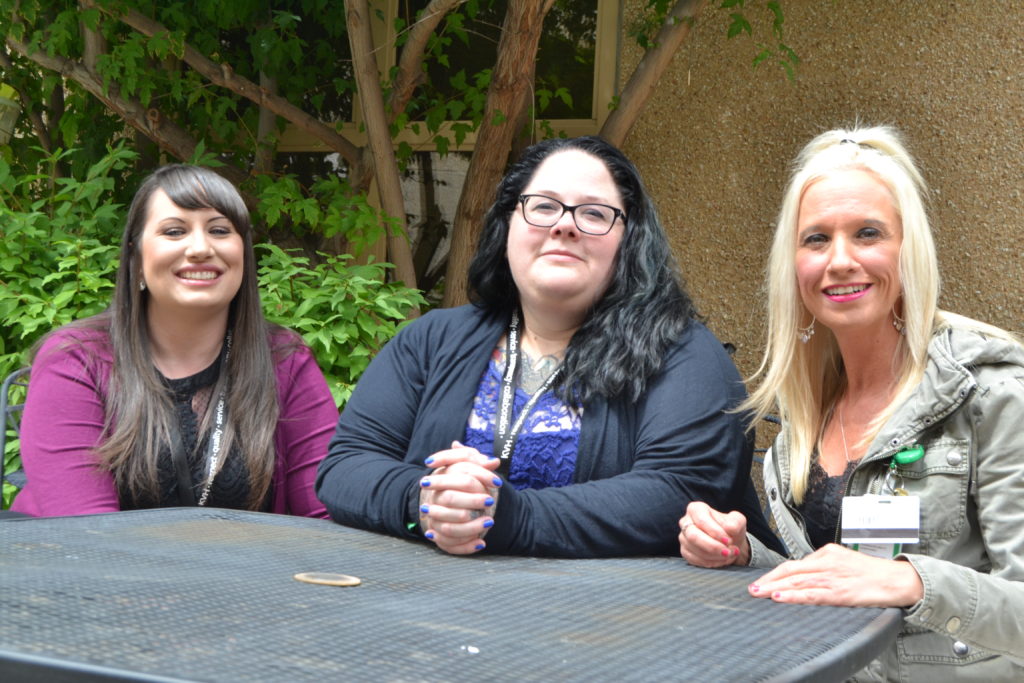
Located in two separate facilities, the KVH Central Billing Office covers a range of services and responsibilities. We sat down with three long-time CBO employees for a glimpse at the work they do to serve our patients, the community, and the organization itself.

Photo (L-R): Tara, Kelly, Leah

Leah, you and Jill and Yvette are the faces of KVH Hospital. What’s a typical day for you?

L: As a Registration Clerk, I register hospital patients for all the different areas, like lab, imaging and emergency. I also train our staff on the patient registration process.

Does everybody in Registration work the main desk and ER?

L: Yes. We train everyone to work at both.

What was it like for you when you first started here?

L: Well, I’ve worked in healthcare since I was 18. Before I came here, I worked at Swedish and at Overlake Hospital. So I was able to draw on those experiences.

So, say somebody comes up to your window and they don’t feel well or they’re upset. How do you deal with that?

L: I’m very compassionate with patients. Some come regularly for care. One patient comes to mind who, when she checks in, she could be crying or happy, but I always reach out my hands for her to grab onto, and she feels better right there.

A lot of folks get comfortable with you and they don’t want to go to anyone else to get checked in. I try to do everything I can.

Tara, what is the billing office like?

T: No day is the same, with the constant changes in payers (entities paying claims, such as insurance) and healthcare.  We review claims for errors and fix them, submit claims to payers, do claim/denial follow up, post payments, send patient statements, and do self-pay follow-up and collections.

And as Billing Office Supervisor, what does your team look like?

T: We have three billers for primary (main) insurance, two billers for secondary insurance (which happens, for instance, when a patient has insurance through their work and also has coverage through a spouse’s insurance – one insurance is primary, the other is secondary), two self-pay financial counselors, a revenue cycle clerk who collects patient payments, and a cash poster who posts patient and insurance payments.

Kelly, what do you do?

K: I’m the Charge Master Coordinator. Tara and I’ve been here just about the same amount of time – 14 years, and some change.

I manage the charge master, which is a database. Anything that could possibly be charged, for clinic and hospital care, is housed either in our charge master or in the pharmacy’s charge master. I work closely with Coding and Billing to ensure every CPT (Current Procedural Terminology) code is attached to a charge, that the codes are correct, that they’re hitting the bill correctly, and that we’re not overcharging.

I audit a lot of accounts. The Quality team reaches out if they need a chart audit done. So by the time it hits my desk, there’s a problem or it’s one we didn’t look at. And then they’ll have denials or claims that won’t get pushed through because something’s wrong. So I look at those, as well.

When people ask, “What do you do?” I’m like, “It’s probably easier to say what I don’t do.”

How have you spent your 14 years at KVH?

K: I started actually in Revenue Cycle Management, which at the time also covered nighttime registration. I did a lot of the cash posting and chart auditing.

T: I started working as a Registration Clerk right out of high school, and also worked for a short time in Home Health before I came to Billing.

So, you all spend a good amount of time on the phone in your jobs. How do you feel about that?

L: It’s more about how the patients feel, right? Until recently, when folks called for Imaging, we’d answer the phone, then they’d be transferred to Imaging’s phone tree. It was backwards. Now, when you’re calling the hospital, a phone tree picks up with options for Billing, Imaging, Lab, HIM (medical records), and ‘Other’. Callers can select ‘Imaging’ and connect with a live person in Imaging. It’s so much better for patients.

Tara and Kelly work in traditional office settings, but your work environment is…

L: It’s like the mall. (Laughter)

With busy times and quiet times. What do you do when there’s no one to register?

L: We have other duties, and we try to do them when we can, but it’s tough to get things done between patients, so we do more on the weekends and early mornings and evenings.

So you didn’t mention the mail, you guys do mail?

L: We take mail out in the morning and then I take it in that afternoon to the post office. 

I’m sure it’s fun when somebody does a massive mailing.

L: Like Marketing. (Ouch!)

What are the challenges of your jobs?

T: One of the biggest challenges we have is keeping up with the changes in healthcare as everything effects our department.

K: People don’t think about us until the end. Absolutely everything that happens upstream stops with us. If it’s broken, if it’s not working right, if the charge didn’t drop, if the documentation isn’t there to support the charges, if there’s the wrong information on the claim because it was registered incorrectly – things that if looked at upstream would make our jobs a lot easier.

T: We have really been working to improve the communication between departments organization-wide. We have implemented weekly and bi-weekly meetings with other departments to discuss any current issues we may be having.

As billers, we are wired to correct issues regardless of where they originated, so we can quickly get the claim out the door. Because of this, we’re not always the best at communicating those issues. That’s why we’ve implemented Registration and Coding work queues, and are able to send any issues we come across back to the departments for corrections. Plus, when we implement changes like these, we see our AR decrease.

L: For registration, the challenge is making sure things are done accurately from the start, with the right insurance and demographics for the patient. Our CFO recently told us our self-pay list went from 4% to 2% after all the training we did at the clinics. That’s a good improvement to help with Billing’s challenges.

In your roles, you’ve got to be compassionate, but do you ever feel like you are absorbing people’s stress? Are you there for each other?

L: Definitely. We also have good bosses. In Registration, Yvette is there whenever we need to troubleshoot or be encouraged.

T: We’re a family. We really are. We’re pretty blessed with our departments.

So you kind of tiptoed into the next question: what are some of the rewards of working in your areas?

L: I love challenges in my job. If there is an issue, I usually can fix it. And when my shift’s over, it’s over. I can go home and be with family and leave work at work.

How do you see what you do as being part of the mission to provide patient care?

K: We talk the patients through complaints a lot of times before they even get to Quality. We’re able to work out billing issues, charge issues, things like that. If we keep the patients happy, we keep them coming back. You know, times are tough right now. Just having a conversation is helpful for many patients, who don’t necessarily understand their insurance, let alone charges from the hospital. Just giving them that additional information, then they’re like, okay, I get it. Nobody wants to pay those bills, but they get it, you know?

T: Even though we’re not providing direct patient care, we are the last department that the patient encounters, so we have a huge responsibility to meet their needs – whether that’s explaining their charges or insurance benefits, or helping them set up payment arrangements. One of our biggest challenges is that most patients don’t understand their insurance benefits.

Anything else you’d like to share?

K: It’s always important to remember what it was like before we got involved in healthcare: how much did we really know? You know, you presented your insurance card and you didn’t worry about it. Remembering that, and having understanding and compassion for patients is so important.

We all feel that way, and it helps that we work with a really good team of people.

KVH Medical Arts Center – Call for artists

HealthNews · July 19, 2019 ·

Kittitas Valley Healthcare seeks to commission artists or artist teams to design artwork for its new Medical Arts Center (MAC) at 100 E Jackson Ave in Ellensburg. The Medical Arts Center will be home to KVH Family Medicine – Ellensburg, KVH Women’s Health, and KVH Pediatrics, as well as other healthcare partners and collaborators.

For centuries, art has played a powerful role in the healing process. Florence Nightingale, the founder of modern nursing, knew about the healing power of images and proclaimed: “Variety of form and brilliancy of color in the object presented to patients are an actual means of recovery.” It is our belief that if art can enhance someone’s mood or take their mind off their pain for a short while, it is no longer just a decoration. It’s part of the entire model of care.

Contact us for more details on how to be involved in this exciting project for our community.

Joe Davis (ER)

HealthNews · July 9, 2019 ·

Joe Davis (ER)

Meet Joe Davis, EHS Class of 2019. ASB President. Football, basketball, and track. An adventurous spirit, ready and willing to take on life’s challenges with the vigor of a healthy 18 year old.

Until the day in December when he ate his first macaroon.

“I figured I’d try it,” says Joe, who took one bite, not knowing the cookie was loaded with almond flour. It wasn’t long before he felt a reaction. “I thought, ‘Oh, there must be some nuts in that.’ And I went to my next class.”

This wasn’t Joe’s first tangle with nut allergies – a condition he shares with his mother, Janet. “There were times where he would accidentally eat nuts,” she recalls. “He’d have itching around his mouth, and his mouth ‘felt weird’ and swollen. Sometimes he’d tell me and sometimes he wouldn’t, but the symptoms would always resolve with time.

“It’s never been a real issue,” declares Joe. “I wait, drink some water, and it’s gone in 10 minutes.” He’d never had to use an epinephrine (“epi”) pen or mobilize the emergency plan established with his school.

This time was different.

“I went to a class for an hour. I wasn’t feeling better, so I stayed at school for lunch. Then I started getting hot and my body was really irritated, so I laid down on the couch in the ASB office.” At fourth period, Joe was joined by fellow ASB officers, who told him in no uncertain terms that he looked horrible. 

“By then I was having a hard time breathing. My breath was really raspy.” Enter the white knight in Joe’s story: his best friend Connor Timko. Experienced with his own peanut allergy, Connor heard the labored breathing and knew what was happening. He told Joe, “You’re going into anaphylactic shock.”

“Thank God for Connor,” says Janet, who in the midst of a busy afternoon was on her way out the door when Joe called her, his voice barely audible. Once Janet figured out what was wrong, she had Joe put Connor on the phone. Her son’s friend described the symptoms he was seeing, and they agreed he should immediately drive Joe to the ER.

“Connor could get him there faster than I could,” she says. “I dropped everything and sped to the ER and met them there.” Within twenty minutes, she was joined by her husband Bob. By then, emergency staff had dosed Joe with epinephrine, steroids and Benadryl, and were closely monitoring his condition.

As a social worker on staff at KVH, Janet often serves in the emergency department. She considers it familiar territory. Nevertheless, “It’s so different when it’s your own kid. Joe is our youngest,” she says quietly, her voice catching.

The ER team involved in Joe’s care included provider Jocelyn Judd, and nurses Doug Henson and Susan Penick. “I have colleagues that hit the ground running and know exactly what to do,” says Janet. “I never felt like there was a question about the exact treatment. I could just be the mom and rely on them to do what they do best.”

It’s been over six months since that fateful evening, and Joe’s life is back to normal, with one glorious exception: certain nuts are now a regular part of his diet. Shortly after the ER visit, Joe had extensive allergy testing, which narrowed down the list of culprits to three: walnuts, pecans, and the one that sent him to the hospital – almonds.

Freed by this new information, on their way home from the allergist, Joe and his mom went shopping for things he’d always wanted to eat but never dared – pistachio ice cream, Nutella, and pesto sauce. “He loves it all,” laughs Janet.

Later this summer, the Davis family travels to Italy. This fall, Joe heads to Japan for a two-year mission, then to an out-of-state college. As terrible as Joe’s anaphylactic episode was for his entire family, Janet has found a silver lining. “Now, Joe can travel knowing he needs to be very careful and carry an epi pen. And he can enjoy foods that used to be off-limits.

“Things were lined up in the perfect way for Joe to get help and information he could use through the rest of his life,” she says, which according to Joe will include college track, and possibly a career in international business or cardiology.

“Whatever the future holds, it’ll be busy,” Joe grins. “I’m excited.”

Safe Sleep for Baby

Elise Herman , MD · July 3, 2019 ·

KVH Contributor*
Elise Herman
Dr. Elise Herman
KVH Pediatrics

Safe sleep for baby

Many parents are familiar with the recommendation that newborns should sleep on their backs, but ‘safe sleep’ is more than just the positioning of the baby. The American Academy of Pediatrics (AAP) has addressed sleep safety both in the 2016 original safe sleep policy (for newborns and infants up to age 1) and in a recent update April 2019.  The Family Birthing Place at Kittitas Valley Healthcare is making safe newborn and infant sleep a focus with materials given to parents in prenatal classes, those delivering at KVH and those whose young child is seen in the KVH Emergency Department.

The fact that annually more than 2,500 babies in the US die unexpectedly while sleeping is tragic. These deaths are often due to SIDS (Sudden Infant Death Syndrome) or accidental suffocation or strangulation.  The “Back to Sleep” campaign in 1994 recommended babies sleep on their backs and as a result the SIDS rate decreased by half. This continues to be the recommendation both for nighttime sleeping and naps. The crib should be free of blankets, pillows, bumper pads, stuffed animals, etc. – some call this “the naked crib”. 

If desired, babies can sleep in a wearable blanket or sleep sack to keep them warm enough at night  –  but not too warm. It is better for babies to ‘sleep cool’ than get overheated while sleeping. Swaddling with a thin breathable cotton blanket is fine until 1-2 months of age. The swaddle should be snug around the chest but looser around the legs so the baby can move her hips freely. It is important that the swaddling blanket cannot get up around her face. 

The sleeping surface should be flat and firm- it should not indent when baby is lying on it. Devices that aim to position the baby a certain way for sleep (like the “Rock N Play”) have been found to be dangerous and are not recommended. Babies should sleep close to the parents’ bed but in their own space (i.e. crib, bassinet, portable crib).  The AAP recommends room sharing ideally for the first year of life but at least for the first 6 months.

Although room-sharing is recommended, bed-sharing is not. Baby may come into the parents’ bed only for feeding and comforting and then be returned to his own ‘sleep space’ when the parent is ready for sleep.  Babies should never sleep on a couch, armchair, or other soft surface as these pose a significant suffocation risk.

Smoke exposure is associated with an increased risk of SIDS; if a parent is a smoker they should smoke outside of the home and change clothes before being near the baby.  Ideally, they should quit smoking for their own health as well as that of the baby’s.

All parents are tired, all parents want their newborns and infants to sleep well, but sleep safety is vital. Having babies sleep in their own space, on their backs, not over-bundled, on a firm, flat surface, and without anything else in the bassinet or crib is essential for sleep safety.

For more information here is the link to the AAP’s policy:  
SIDS and Other Sleep-Related Infant Deaths:  Updated 2016 Recommendations for a Safe Infant Sleeping Environment https://pediatrics.aappublications.org/content/138/5/e20162938

*Opinions expressed by KVH Contributors are their own. Managed by Kittitas Valley Healthcare, HealthNews does not provide medical advice. For medical advice, please see your healthcare provider.

Behind the Scenes: Finance

HealthNews · June 19, 2019 ·

Finance

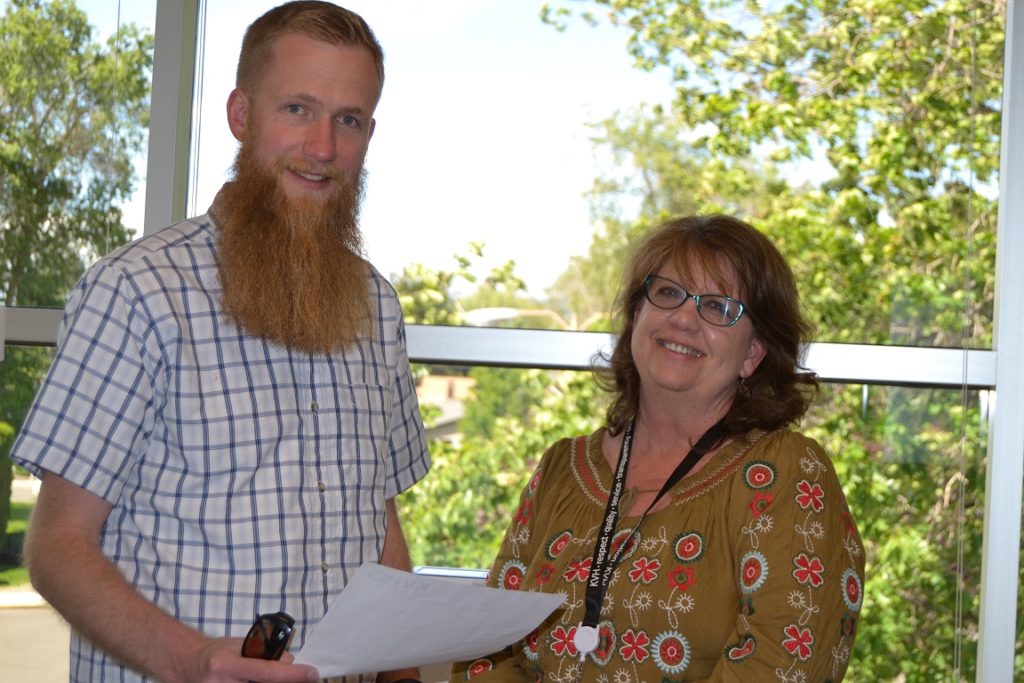
We sat down with KVH Senior Finance Analyst Jason Adler and Accounts Payable Specialist Deborah Connors, to try to get a handle on the mystery that is healthcare finance.

How is the work divided between the team in your department?

Jason: Accounting is a part of finance, and finance is also the whole revenue cycle. They all partner together.

Deborah: And you do a lot of budgeting.

Jason: I do the budget and it rolls into accounting to compare the budget or financial plan to the actual accountings.

Deborah: I have a very small part of the whole accounting department. Pretty much just paying the bills.

Jason: Well, I think she has a really big part. How much money did you spend last year?

Deborah: You know, I don’t remember, but I did hear Kelli [Goodian Delys, Finance Director] say that I wrote over 10,000 checks. One night I was here until 7:30 doing checks and someone’s like, wow, you’re here late. I’m like, I’m just trying to keep the lights on.

Jason: Literally.

If you were to give a really high level of what your teammates do, what are the different roles? Kelly Winters does payroll.

Deborah: Kelly does payroll. I pay the bills. Vicky Sterkel pays the bills. She enters employee deductions and things like that. She also sorts the mail that comes in and helps do a lot of data entry in Cerner for matching invoices to purchase orders.

And Sharoll Cummins?

Deborah: Sharoll does just about everything else.

Jason: She puts in journal entries to account for things like bills we haven’t paid yet, like when a company bills us about a month behind, but we need to expense it at the time of service to ensure we have the money for it.

Deborah: Sharoll also keeps track of all the fixed assets, whether it’s a new computer system or a building.

What program do you use for all of this work?

Jason: We probably use Excel the most. Multiview is our general ledger software. So that’s where everything comes together in our general ledger, which is like the book of truth, I guess you would say.

What’s different about working in finance in healthcare?

Deborah: I had to learn a lot of terminology. My first six months I googled a lot of things, many of which I wish I’d never looked up. But, accounting is accounting. The basic principles are the same. It’s just the terminology that is a little bit different.

I just know from my perspective in marketing, but marketing in a healthcare environment has that layer of ‘it’s for a greater good.’

Deborah: That is actually part of what drew me to wanting to come to work here. You know, being part of an organization that does good things for people.

Jason: I guess one of the biggest differences with healthcare is learning how we actually get paid, and what we can charge for. Every payer pays us differently.

Deborah: Incredibly complicated.

Jason: Yeah. And contracts with insurance companies will conflict. You might have a contract with one insurance company where a service is allowed and paid for and another company that is complete opposite.

Deborah: There are a lot of things that are very negotiable.

How do you keep all of it straight?

Jason: It takes the whole team. There’s little things like with Medicare and Medicaid where location is really important on how you get paid. We can do the exact same service in two different areas and what we get paid for the services can be significantly different.

Deborah: And even things like the utility bill. Engineering absorbs most of the utility bills into their department, but not all. The ones for the Rural Health Clinics get charged to the clinics, so they can be included on the Medicare Cost Report reimbursements.

I think that’s the single biggest thing that I learned since coming here, is how complex the entire finance system is.

Jason: We do the cost report, so we’re paid on cost from Medicare and Medicaid, which is about 60 percent of our business, but pays about 33% of our costs by the time we factor out all non-allowable expense. It’s just accuracy with the most basic things such as square footage of my office compared to a patient room. Just the square footage makes a huge difference on payment for services.

Speaking of having numbers right, how often do audits come into play?

Deborah: Two a year.

Jason: The state audit, and the independent audit.

Deborah: It’s my understanding that government agencies whose revenue exceeds a certain dollar amount are required by law to have independent audits done on an annual basis.

Jason: It’s required that the board choose a firm for the independent audit. Our firm is DZA and they just did the report out at the last board meeting. We have a state audit every fall.

Deborah: We don’t just go, “Hey, it’d be a great idea to get audited.” It’s required by law.

Jason: We’ll have payers do audits, too. We hire a third party audit to audit patient accounts. Just at random, to check that we’re doing a good job.

Deborah: And that’s a big part of the audits. It’s not just “What are you doing wrong?” It’s like, “This is the way we’ve been doing things. Can we do it better?”

What are the challenges of finance?

Deborah: I have a huge volume of work that comes through. It never stops.

Jason: Yeah, the volume’s a big one. I’ve just learned that even though I’ll have some periods with tighter deadlines, I do what I can, and at the end of the day I go home, because it’s never really done.

Rewards of working in finance?

Deborah: I like solving puzzles. Accounting’s a big puzzle. Sometimes you don’t know what it’s supposed to look like, and I like that part of it.

Jason: Being part of a community hospital and community health care. I know that I need health care, my family needs health care, and it’s great to be a big part of this and then know the numbers, the behind-the-scenes of why we do everything.

We try to keep it improving continuously for the small community. It feels like I’m actually helping friends and neighbors, unlike a big city where it’s thousand people I don’t know. I see patients I know every day. It’s really rewarding.

What would you tell a new teammate to bring with them for a successful day on the job?

Deborah: I’d say patience and a sense of humor.

Jason: Ditto. Especially patience.

For many of us, being in a hurry with our work can create more problems than we’re solving.

Deborah: Yeah, that’s true. I usually find when I’ve made mistakes, it’s because I’ve got rushed through something.

Jason: I like to try to have a second set of eyes on things.

Any misconceptions that folks tend to have about finance that you would like to dispel here or anything that people might find interesting about your work?

Deborah: Well, I don’t think accounting is boring, but a lot of people do.

Jason: Yeah, I don’t think a lot of people are going to find accounting interesting.

Well, but they’re seeing it from the outside, right? Getting directly involved in it might make it interesting.

Deborah: I think people might be surprised to learn that just because you work in accounting doesn’t mean you don’t have to be able to relate to people really well, because a lot of what we do is talking with people. Even if most of it’s in emails and spreadsheets, you still need to be able to communicate really well to do accounting.

How does your department’s work support the KVH mission of quality care?

Jason: Well, there’s access and financial sustainability too, right?

Oh yes. Our core values. If you couldn’t afford to have the doors open. You said something before about the lights being on.

Jason: Well, timely bills keep supplies coming in and the lights on.

Deborah: And monitoring those expenses in addition to the revenue, just to make sure that we’re not paying more than we need to, that we’re not getting taken advantage of.

You also are making it so that there’s a future here. We have, like, rainy day funds and we have operating costs and, I mean, all that stuff is all, you know.(Because clearly, I don’t know.)

Deborah: And in that way it’s not a lot different than your household budget. You always have to put a little money aside because you never know when that money coming in might slow down.

Just on a much larger scale here.

Jason: Exactly.

It’s pretty important work you all do. I still don’t understand a lot of it, but I’m really glad you’re here to take care of it all.

Behind the Scenes: Community Relations

HealthNews · June 6, 2019 ·

Normally, Behind the Scenes pieces open with the line “We sat down with…,” but in this case, Community Relations intern Arianna Walker wrote the post herself from start to finish. As you’ll see, she has a wonderful writing voice. Our team has enjoyed working with Arianna over the past months, and we warmly congratulate her on earning a Bachelor’s in Public Relations. Watch out world, here she comes! 

Arianna Walker

There’s no place like marketing…I read that phrase every day that I’m in my office. This is mostly because it’s taped to the stapler that sits on my desk, but this phrase has also grown on me in the past couple of months.

I’ve been a public relations/advertising student at CWU for around two years now. Before that, I took courses in communication studies and graphic design. The experience I’ve gained through doing public relations/advertising in the classroom has helped me discover an enthusiasm and a passion for this line of work. The more I’ve learned, the more I have wanted to go out and experience this career in the real world.  KVH Community Relations gave me the opportunity to do this.

I heard about this KVH internship opportunity through my boyfriend’s uncle, who works at KVH. He was aware that I was looking for an internship for my last quarter of school and told me that Community Relations was interested in having a student intern. I jumped on the opportunity because it sounded like the perfect fit: something in town, something close by, and an opportunity to use my skills and knowledge in a real-world setting.

Before starting as an intern here, I hadn’t thought much about public relations/advertising in the healthcare industry. Even though I have learned in my studies that public relations is a need across almost all industries, I mainly associated it with companies that market products or food and companies that market specialty services. I was not sure what to expect in terms of projects, content creation, advertising, and other areas. The work I have done has been just the kind of experience I’ve been looking for.

During my two months interning in the Community Relations Department, I have worked on a variety of projects and utilized my skills and knowledge in multiple ways. I have created advertisements, assisted with event coordination/scheduling/promotion, created a newsletter, written web content, and so much more. I have also had the opportunity to work with two women who are experienced professionals. Michele Wurl and Jan Powell have both given me constructive feedback on the work I’ve done, which has helped me learn and grow as a professional. 

The most rewarding part of this internship has not only been seeing the successful finished products that I have created, but also the value of the experience I have gained. I have been able to see my hard work put in motion and produce results. The work I have done for KVH has been rewarding and valuable experience for my career.

Another rewarding part of this internship is the people I’ve met and the acquaintanceships I’ve made. Michele and Jan have both been a pleasure to work with and have supported me throughout my time here. I have also met most everyone on the administrative team and all of them have been friendly and have made me feel at home here.

The skills and professionalism I have gained during my internship are things I will carry with me as I begin my career after college. I am truly grateful for this experience and opportunity to “dip my toes” in the KVH Community Relations pool.

  • « Go to Previous Page
  • Page 1
  • Interim pages omitted …
  • Page 12
  • Page 13
  • Page 14
  • Page 15
  • Page 16
  • Interim pages omitted …
  • Page 20
  • Go to Next Page »

Primary Sidebar

Categories

  • KVH Stories
    • Patient Stories
    • Provider Stories
    • Donor Stories
    • Employee Stories
    • Volunteer Stories
    • Share Your Story
    • All
  • Blog Posts
    • Behind the Scenes
    • Childbirth & Family Education
    • Community
    • Health
    • Lifestyle
    • Provider
    • Safety
    • COVID-19
    • All
  • News & Media
    • KVH News
    • Weather/Disaster Notifications
  • Press Releases

Footer Top 2

603 S. Chestnut Street - Ellensburg, WA 98926
509.962.9841

  • Facebook
  • Instagram
  • LinkedIn
  • YouTube

Footer Bottom 1

Download the MyPatient Portal App
Apple Store Google Play Store

Footer Bottom 2

  • About KVH
  • KVH Legal Information
  • Price Transparency
  • Careers
  • Board of Commissioners
  • Contact Us
  • The Foundation at KVH

Footer Bottom 3

  • Our Locations
  • Hospital Services
  • Clinics & Specialty Services
  • Visiting Information
  • Patient Policies
  • Events & Education
  • Press Releases

Footer Bottom 4

Google Translate